The United States Faces a Conundrum in Iran

Today, I joined CNN News Central to talk about where we are on Iran. The United States faces a conundrum. The Iranian regime is not going to be cowed into a nuclear deal, particularly zero enrichment (which I find hard to believe they would do), without major, major concessions from us. Those concessions, even if some sound good (like US economic opportunities), mean significant sanctions relief, i.e., lots of money flowing into this economically and morally bankrupt and dangerous regime. After killing so many Iranians, can we do that deal? And can we, should we do that deal when Iran’s missile force is an actual and growing threat that would worsen with sanctions relief? Hard to imagine we would. So we could walk/sail away, which makes us look weak. Hard to imagine. Or use our massive force to strike Iran. That’s getting easier to imagine.
Read More »

Trump Administration grappling with Iran policy

We are not even halfway through the first month of the New Year, and there is more going on geopolitically than ever. Here is my take from last night on Iran with Kaitlan Collins and Congresswoman Yassamin Ansari on CNN. The President and his team are meeting today (Tuesday) at the White House to decide how to respond to the Islamic Republic regime’s brutal repression of its people. The options include diplomacy, covert action, a range of military options, or a combination of these. Unlike the first Trump Administration, our partners in the region (Gulf states and Israel) oppose U.S. military strikes on Iran, at least at this juncture, fearing Iranian retaliation. Formulating U.S. policy is not easy. The considerations that must be weighed include: The reputational/deterrence risk of not doing enough to back protesters being murdered by the regime and to back up Pres. Trump’s public warning that the U.S. is “locked and loaded” and will respond militarily if the regime kills protesters (that red line has been crossed); The risk of Iranian retaliation or a pre-emptive strike against Israel and Gulf partners when the US now lacks the aircraft carrier and other assets that were essential in providing

Read More »

U.S. Strategy of Sanctions Against Venezuela and Russia

Context matters. Both in the case of U.S. policy toward Venezuela, where Washington’s goals are clouded by domestic political issues, and Russia-Ukraine, where the U.S. posture toward Europe and Russia ultimately will affect the durability of any peace. In this clip, I tackle both subjects, including the purpose and effectiveness of seizing sanctioned Venezuelan tankers and why the overarching approach of the US toward Europe and Russia matters.

Read More »

Historic Day for the Middle East

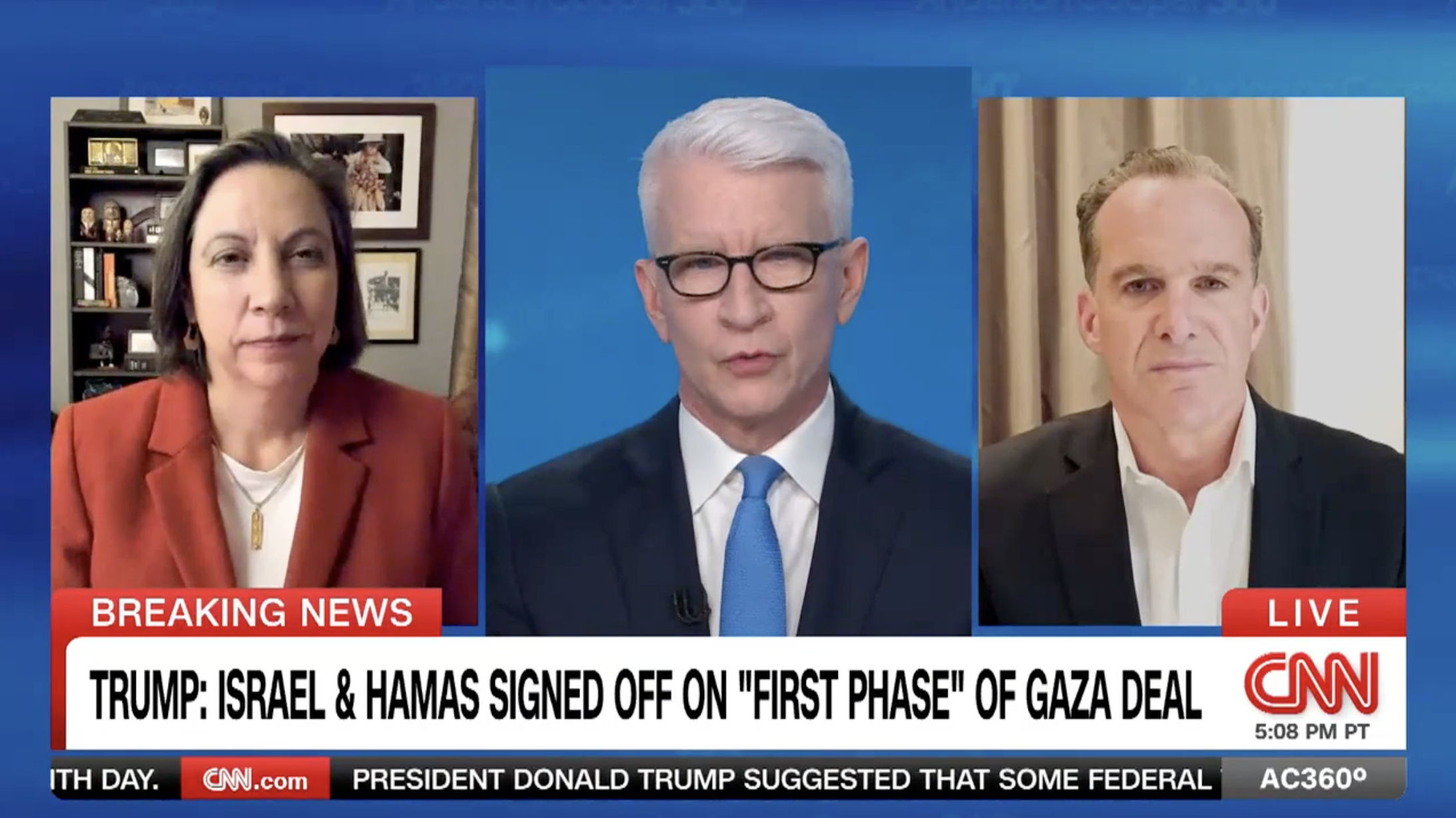
I joined Anderson Cooper 360 with Brett McGurk to talk about this tremendous, historical day in the Middle East. I’m hopeful that we will see Israeli living hostages returned to their families by this weekend. I also hope that a return of most of the deceased hostages, a partial withdrawal of IDF troops, and the beginning of a massive influx of aid for the people of Gaza will follow. President Trump deserves enormous credit for bringing this about. He did two things that fundamentally changed the dynamics. First, regarding Israel, he recognized the overwhelming Israeli public desire to end the war, that the endless, devastating war was unsustainable, horrific, and counterproductive for Israel (and, by extension, the U.S.), and that he needed to force Netanyahu’s hand and give him no option but to accept the peace plan. Second, President Trump worked with the momentum in Europe and among the Muslim countries in support of a Palestinian state to forge Muslim leadership support (and input in) his 20-point peace plan. This was a monumental change; Muslim leaders from Qatar, Egypt, and Turkey gave Hamas no option but to accept this first phase of the plan (hostage/prisoner exchange). At the risk of

Read More »

Sabotage Without Warning: ​Why the Gray Zone Could Be America’s Biggest Blind Spot

Below is a partial transcript from The Cipher Brief’s Gray Zone Group. The briefing has been lightly edited for length and clarity. For more background on recent Gray Zone attacks, the Cipher Brief has a good rundown. The Cipher Brief: How are you thinking about the increase in activities and what concerns does that lead to? Dr. Vickers: The UK and Germany have both noted the expansion of Russian activity, and it’s also become more lethal. During the Cold War, Russian intelligence services focused principally on intelligence. The KGB utilized active measures, mostly propaganda, sometimes some wet affairs (operations that involve assassination or murder). Russia’s GRU does a lot of that now; sabotage and assassinations and other things that are being noticed across Europe, as well as deploying new cyber tools. And disinformation launched by China in Taiwan has really intensified substantially. Pitts: When you look at the increase in activity by adversaries, it tells us that they think this is an effective strategic effort and that it is working. That’s bad for us. It means all the things that we’re doing to highlight and deter it aren’t working, at least not to the extent that they should. I think we should also look at

Read More »

Gaza Starves While World Fiddles

The Gaza peace process seems over for now. I said in this clip on 25 July that the US withdrawal was a negotiating tactic. I don’t think that is where we are now. Pres. Trump seems increasingly frustrated with the humanitarian situation, but is still basically saying this is Israel’s problem, except that we look complicit given the “Gazan Humanitarian Foundation” food delivery system. Pres. Trump also said he is talking to Israel about alternatives for getting the hostages freed. There is only one real alternative: a military operation. This would/will be very dangerous and difficult given the likely location of hostages in areas where Israel has not conducted significant or any operations. Special Envoy Dermer and National Security Adviser Hanegbi are in Washington today to talk about next steps for Gaza.

Read More »