Regions

Beth’s trusted analysis on countries and regions, such as Ukraine-Russia, China, the Middle East and Iran, India, and Europe, provide information leaders need for action and the public needs to understand our complex world.

Wagner Group Leader Yevgeny Prigozhin was a violent man who lived life on a knife’s edge; that he reportedly met a violent end seems both fitting and unsurprising. Most commentators have made this point, remarking that the only surprise was that it took so long.
In the wake of Wagner boss Yevgeny Prigozhin’s 36-hour mutiny and the scant and the confusing smoke signals emanating from the Kremlin since then, evidence of Vladimir Putin’s decision-making disfunction and his way forward are coming into focus. How he manages these issues in the coming weeks may very well determine Putin’s ability to maintain his grip on power over the long run.
It appears that the U.S. Intelligence Community scored a success in warning senior leaders that Wagner boss Yevgeny Prigozhin was planning some sort of armed action against the Russian military.  We would not have known that had not people inside the U.S. Government shared this with the press. 
President Biden is about to depart on a trip with an ambitious itinerary: meetings on climate at the COP27, on relations with Southeast Asia at the U.S.-ASEAN summit, and on a range of political and economic issues at the G20. With so many high priority topics to cover, what’s realistic to expect? What are the big challenges that the White House should focus on? And how might the outcome of this week’s elections factor in?
Prior to Russia’s invasion of Ukraine in late February, the prevailing view in Washington was that Russian President Vladimir Putin had become a master of the geopolitical game. He had a well-armed and capable war machine and had managed to extend Moscow’s influence well beyond Russia’s near abroad into Africa, Latin America, and the Middle East. Yet although Putin has not lived up to this hype given his disastrous late-February blitz, the pendulum has swung too far in the other direction.

This month, protests in Kazakhstan sparked by a sharp increase in gas prices and caused by discontent with the government spread across the country. The unrest and the ensuing violence serve not only as a cautionary tale for other Central Asian countries but also as a wake-up call for the United States.
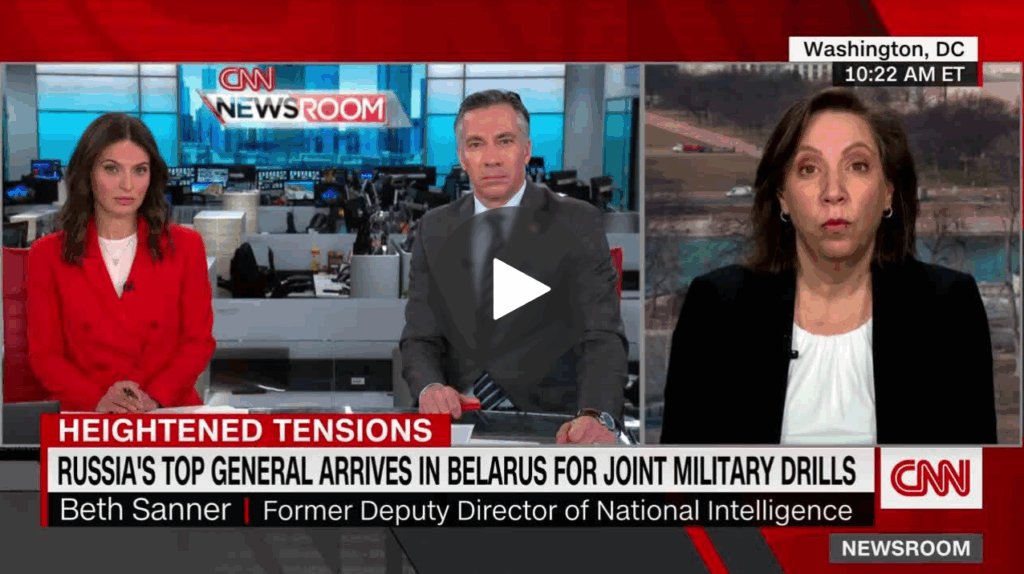
In this CNN appearance, presidential intelligence briefer and 35-year national security leader Beth Sanner breaks down the heightened tensions between Russia and Ukraine, as well as how events are escalating at the border between the two countries. As a senior-most analyst in the U.S. Intelligence Community and the former Deputy Director of National Intelligence, Sanner has observed Russia for several years and speaks expertly to its goals in this conflict, as well as when a potential planned offensive could take a place.