Moscow’s war on Ukraine has certainly revealed Russia to be weak, which will inevitably undermine Putin’s global influence. The hedge against U.S. decline and withdrawal that Washington’s partners, especially those in the Middle East, have undertaken with Moscow will likely come to an end. After all, who would want Russian military equipment and doctrine after such spectacular military failures as, for instance, the attempted crossing of the Siverskyi Donets River, during which Russia lost an entire battalion. Of course, the Russians seemed to have recovered and learned from these disasters, proving themselves more effective in more recent battles in Luhansk and Donetsk.
Yet for all of Russia’s military shortcomings and Western efforts to make Moscow an international pariah, not only does Putin remain a capable player in the Middle East, but he also has willing partners there.
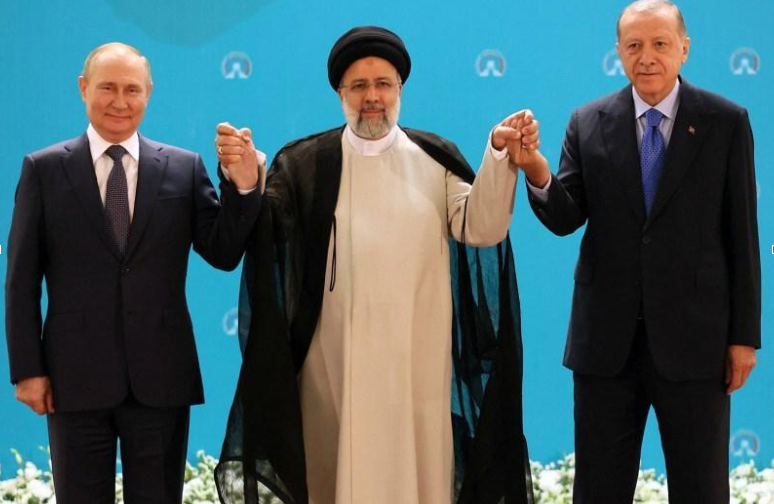
On Tuesday, perhaps in a direct response to U.S. President Joe Biden’s recent trip to the region, Putin traveled to Tehran for a meeting of the Astana Peace Process with his Iranian and Turkish counterparts—a trilateral effort to manage the three governments’ competing interests in Syria’s decadelong conflict.
Previously uneasy partners in rescuing the Bashar al-Assad regime, the Russians and Iranians have drawn closer to one another since Russia’s invasion of Ukraine. Tehran has expertise that Moscow wants, specifically on how best to skirt Western sanctions. The Iranians also produce military equipment the Russians need, in the way of lethal drones to attack Ukraine’s Western-provided advanced weaponry. Iran also has historic and current geographic significance to Russia, serving as the gateway to much of the Middle East and the Persian Gulf.
Turkish President Recep Tayyip Erdogan had his own agenda in meeting with Putin and Iranian President Ebrahim Raisi. After presiding over the Turkish-Iranian High-Level Cooperation Council, Erdogan pushed his main objective: an agreement to launch another Turkish incursion into northern Syria, where Erdogan wants to set up a safe zone for the forcible return of Syrian refugees—likely a popular move at home ahead of a dicey election next year.
Moscow has long resisted a Turkish offensive, because Turkey’s territorial control in the north would jeopardize Putin’s vision of victory in Syria as a unified country under Assad’s leadership. Yet Putin may be willing to countenance a limited and temporary Turkish invasion, because it would complicate the U.S. mission in Syria and exacerbate strains in NATO over Ankara’s relationship with Moscow.
Despite their differences over Syria, Libya, and Nagorno-Karabakh, both Putin and Erdogan chafe at a U.S.-led order in the regions around them—especially in Europe, the Eastern Mediterranean, and the Middle East. This is where the Gulf states come in. If Biden’s recent visit to Saudi Arabia was in part to shore up that order in an era of great-power competition, it does not look like he achieved all that much. This is because few in the Middle East want to make a choice between Washington and Moscow—or Washington and Beijing, for that matter.
Washington’s friends in the Middle East undoubtedly want U.S. security guarantees and lots of weaponry. Yet the combination of two decades of failure in the region, the clear U.S. desire to de-emphasize the region in favor of Asia, and ongoing U.S. domestic political dysfunction raise questions among the region’s potentates about Washington’s commitment to regional stability and their security. The meager results of Biden’s visit to the region suggest that none of the regional actors, especially in the Gulf, are willing to give up their hedges with Russia or China.
During Biden’s visit, Saudi Crown Prince Mohammed bin Salman explained that his agreement with the U.S. president to produce more oil was contingent on market conditions and agreement by OPEC+ members. In doing so, the crown prince, perhaps posturing for effect at home and in the region, was implying that ties to the United States do not trump his relationship with Russia—the most important member of the “plus” part of OPEC+.
It would not be a good look for him to be doing Washington’s bidding, especially after so much Saudi chatter about the kingdom’s global importance and dynamism, and Biden’s very public pledge to censure the crown prince over his role in the assassination of Washington Post columnist Jamal Khashoggi. Clearly, Mohammed bin Salman will continue to play hard to get while seeking more U.S. concessions, particularly in the way of arms and economic deals.
Xi and Salman walk side by side, both waving.